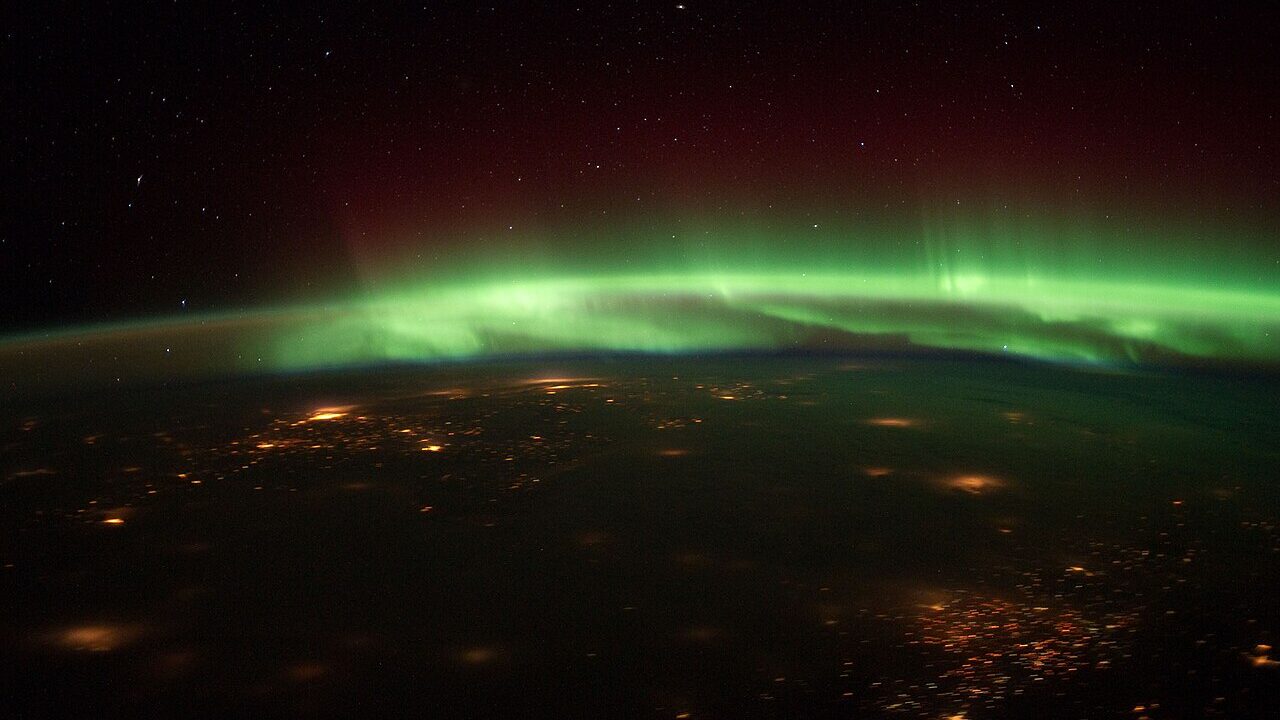
A complete auroral oval has been recorded from space in ultraviolet light, encircling one of Earth's magnetic poles as the solar wind worked on the magnetosphere, in images from the joint European and Chinese SMILE spacecraft published as NASA's Astronomy Picture of the Day on October 6. From the ground an aurora can fill the sky while showing only a fragment of the ring; only a spacecraft high above the pole sees the whole structure at once.
The time-lapse covers about an hour in late July and shows the ring brightening, shifting and churning — variability that is the scientific point. Auroras are the visible edge of energy arriving from the Sun, and the oval's shape tracks how that energy couples into the upper atmosphere. The points of light at the frame's edges are distant stars, appearing to drift as the spacecraft's view shifts in orbit.
SMILE's purpose is to understand how the solar wind interacts with the magnetosphere well enough to protect astronauts, spacecraft and ground electrical grids from solar storms. A storm that paints a beautiful oval can also induce currents in power networks and degrade satellite electronics; the same dataset serves the forecasters who warn operators and the physicists who model the coupling.
Ultraviolet imaging adds a further capability the feature notes: the oval was recorded in daylight. Ground cameras need darkness, which blinds them to half the planet's auroral activity at any season. A spaceborne ultraviolet eye keeps the ring under watch continuously, through the polar day as well as the polar night.
Express News Bulletin attributes the imagery and mission purpose to the European Space Agency, the Chinese Academy of Sciences and the SMILE team as published by NASA's Astronomy Picture of the Day, whose daily explanations are written by professional astronomers. The October 6 feature is the authoritative description of this image.
The image also has a forecasting afterlife. Oval position and brightness feed the empirical models that warn satellite operators to safe their instruments and grid operators to watch transformer loads. Each clean, complete oval captured in daylight extends the dataset those models train on into conditions ground cameras cannot see. Beauty brought this image to a daily astronomy feature; utility is what will keep the spacecraft funded to take the next thousand.